

NYC Graffiti: A Collective Voice
Christopher Forzani
Photo III – Photojournalism Project
Project Statement
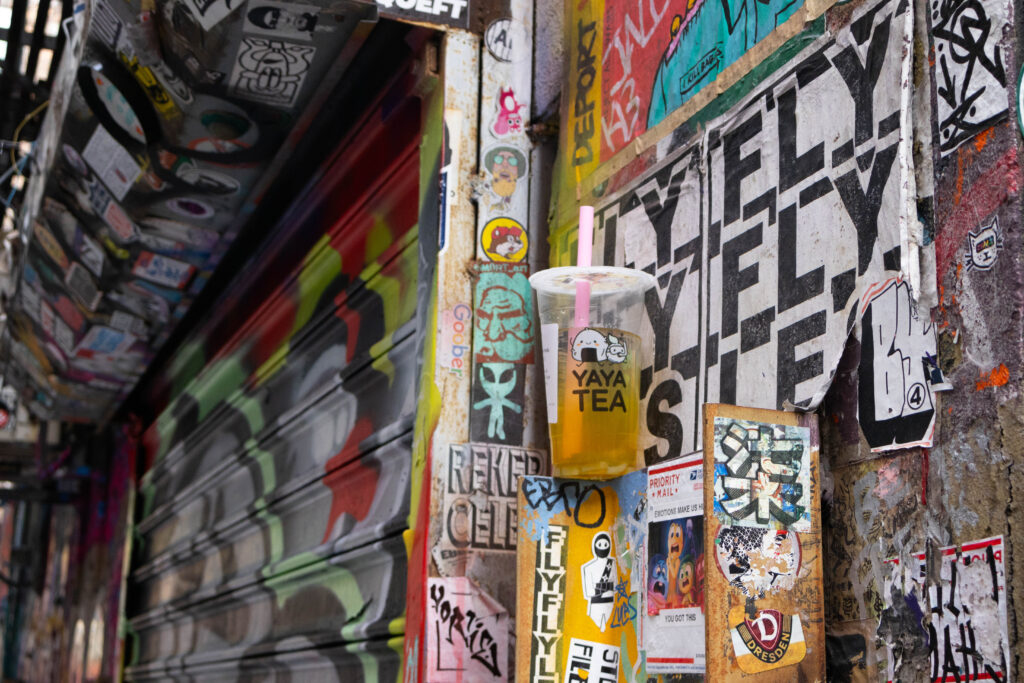
This project documents graffiti in New York City as a form of visual storytelling and communication rather than just vandalism. I focused on how graffiti exists within public space and how individual marks contribute to a larger collective narrative. The lead image, a door covered in stickers, tags, and small graphics, was chosen because each sticker represents its own voice, and when viewed together they create a dense visual record of personal expression. Throughout the project, I aimed to photograph graffiti in a way that preserves detail, layering, and context, emphasizing how these works interact with the city’s architecture and everyday movement. The project reflects graffiti as a temporary but meaningful presence that constantly changes alongside the city itself.
Research & What I learned
Through visiting New York City and researching graffiti culture, including viewing the documentary Exit Through the Gift Shop by Banksy and Thierry Guetta (Mr. Brainwash) and interviewing a graffiti writer named Romek, I learned how graffiti and street art function as both personal expression and public dialogue. The film highlights the tension between authenticity, commercialization, and anonymity within graffiti culture, which helped shape how I viewed the work I photographed. Speaking with Romek reinforced this perspective, as he explained that graffiti is not always driven by rebellion, but often by creative growth, skill development, and the relationships formed between writers. Additional reading on the history of graffiti reinforced how public space has long been used as an alternative gallery for artists seeking visibility outside traditional institutions. This research influenced my approach to photographing graffiti as something temporary and layered, requiring careful framing and attention to detail to preserve moments that may no longer exist.
Lead Image Cutline (The Door of Stories)
A door in New York City layered with stickers, tags, and hand-placed graphics becomes a collage of individual voices. Viewed at a larger scale, the image allows close examination of each mark, highlighting how small personal expressions combine to form a shared visual language within public space.
Interview
What’s your name, artist name, and where are you from?
I am a writer from Australia called Romek.
How did you first get into doing graffiti?
My story is actually very simple. So in high school I wanted a cooler signature to show off to my friends, basically, and just like when I signed papers and stuff, it would look very cool. And so basically what I did was I just googled graffiti tags, and I kind of copied specific letters that I liked, and I wrote my name in a graffiti style. And ever since doing that I just never really stopped because the technique and the creative aspects and like the unorthodox ways you write the different letters, it really intrigued me, and I just wanted to see how far I can develop.
What does graffiti mean to you personally?
So graffiti itself actually doesn’t have much meaning to me. I think the reason why I keep doing graffiti and I never stopped, isn’t even because, like, it’s been deeply rooted into my life or like, um, some, like, rebellious or dissatisfaction with society. It’s not anything like that. I think the biggest meaning that graffiti has to me is the friends that I made while doing it, and the people that I got to meet while doing it. Like, all these, um, other writers, all these other taggers, and their unique styles and their personalities, and just like the different lives they lead. Because when you get into this kind of business, um, people, people’s lives get really chaotic, [chuckles] right? So it really opened my eyes and let me meet a bunch of different people that has– that each have different per- personalities and circumstances. And, um, I think this, this is really the biggest meaning that graffiti has to me. It’s just like these friends that I got to meet and I got to make.
Why do you like choosing public spaces as your canvas instead of galleries or social media?
I think this reason mostly comes from the sense of freedom and thrill that graffiti itself gives. Because anyone can do a piece or throw your tag on paper, right? It’s not hard, and you can take your time and take as long as you want. But when you go outside into the real world with spray paint or little markers in your bag, the world becomes your canvas. Suddenly, you’re not confined to a paper, and you’re not confined to just a white background. You can tag anywhere you want. Of course, there are rules in graffiti that you have to follow if you don’t want to disrespect other writers. However, apart from that, basically everything else is, uh, free game. Everything else is, um, allowed. You can tag up, uh, businesses, you can tag up houses, you can tag up public parks, you can tag up just skate parks and, uh, uh, just, uh, dumpsters, anything you want. You’re no longer confined to that small area. And another thing is the thrill that comes with it, because when you, when you start doing graffiti in the public spaces, you realize that, um, it’s a lot harder than you thought it was. It’s a lot harder compared to, um, doing stuff on paper, right? Um, number one, there’s can control, et cetera. But the biggest risk, the biggest thing is just getting used to people staring at you, getting used to, uh, being able… Recognizing patterns, and just being able to hide and run away. You know, it’s just like all of these things combined gives graffiti a– makes graffiti take a lot more skill and also a lot more fun and thrilling.
How does your area influence your work?
I live in Australia and in a city that isn’t big compared to big cities like Melbourne and Sydney. Uh, it’s a much, much smaller city, and I think the biggest environmental impact that this city has brought to my graffiti art is mostly just the style inspiration that I get from other writers as I go out on trips, et cetera. Because, um, everybody’s style is different, and people here aren’t, definitely aren’t bad at graffiti. They’re definitely pretty good at graffiti. But, um, the environment itself doesn’t really have much of an, too much of an impact apart from this on me personally.
How do you feel about the line between graffiti, street art, and vandalism?
So graffiti is basically the art of lettering. It includes street art and vandalism, but it’s mostly just how you can combine letters, and it should include name and, um, just letters in general. Um, which means that graffiti excludes Banksy and similar artists because, um, I feel like that would count more towards street art and not graffiti. And now street art is something like Banksy, where it’s not letters, not name, um, and it’s not a tag, et cetera. It’s, uh, it’s just like art on the street, um, whether it be legal or illegal, because street art can be both. And now vandalism is illegal graffiti on the wall. So vandalism is just what it means. It’s like destruction of property, um, right? So like, if you paint on a person’s wall illegally, that just counts towards vandalism.
Do you think graffiti loses or gains meaning when it becomes commercialized or displayed in galleries?
Personally, I think yes, they definitely do, because imagine you see a piece or, um, graffiti on, like, a really, really tall building. You can imagine what someone went to make it, right? They had to go into the building with picklocking or wire cutters or hammers, and they had to break down locks to get to the roof. Then when they were on the roof, they had to be quiet, and they had to stay away, and they had to hide themselves and make sure the police will not call on them. They had to dodge security guards, they had to dodge security cameras and all of that, right? And they had to prepare the materials and carry probably, like, at least two kilograms of paint up many flights of stairs to make that piece. Same with, like, you see graffiti on a train, or you see graffiti in a tunnel. You just, you just know the amount of risk that they took to make it, and that is what gives graffiti its meaning, right? And even if you see graffiti on a legal wall, you can really appreciate the effort that goes into it because, um, uh, obviously, spray paint is a lot harder to control than what, what most people would think it is. So I think if you take these pieces and you put them in a gallery, much of the effort and the actual meaning and the dedication behind it goes unnoticed. And especially if you commercialize graffiti, because graffiti is an act of rebellion. It’s meant to be sort of, like, illegal. It’s meant to be like vandalism. It’s meant to be… It’s meant to be the act of a fr- free spirit, you know? Like a person who just wants to do whatever they want. Like, they want to trespass, they want to urbex, they want to do all these risky things, train ride, et cetera, right? Now, when you commercialize it, when you advertise it to people, it suddenly, suddenly it just feels like, um, it loses some of its, some of its meaning, right? It loses some of its meaning. That’s just how I feel personally.
Is there a piece you made that meant the most to you and why?
Um, yeah, there definitely is a graffiti piece that has meant the most to me, um, because it was where my skill kind of skyrocketed from that point. After I made that piece, I realized that this is the path and the style that I wanna continue on, and I wanna just dedicate myself to this style, right? 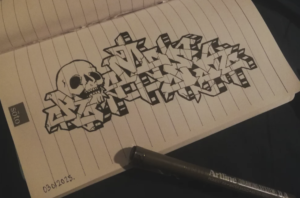 And then from then on, my, my capability, like my ability to paint and my ability to draw graffiti just increased a lot. And the piece is like a wild style, and, um, it was using the name Romek, and I put a skull instead of the O. And I think, um, the piece was probably one of– was my first ever, like, really, really good wild style. Um, but it’s not my best, but it’s probably my first ever good wild style.
What advice would you give to someone trying to understand graffiti culture from the outside as an artist?
The best advice I can give to someone who’s trying to understand graffiti culture from the outside is, just try to be more open to what people do. Because people in the graffiti culture, it can get pretty chaotic, right? Um, people can– they get into a lot of fights, you know, they, they have to sneak into a lot of properties illegally, and they probably do a lot of questionable things, right? Um, you just have to be open-minded and just kind of, um, accept these things if you wanna look at it from the outside and be res- as respectful as possible, right? Um, obviously, people in graffiti, right, they, um, it’s kind of like, um, uh, I don’t know how to say this, but people in graffiti, they like to do a bunch of, not other illegal things, [chuckles] not just, not just graffiti, such as, like, they like to steal all, like, paint from hardware stores. Sometimes they do drugs. You know, sometimes, sometimes they like to, you know, rob people and stuff like that. You just have to be open-minded and accept everyone for their circumstances, right? Um, that’s the best advi- advice I can give to someone who’s trying to understand graffiti culture from the outside and also be respectful at the same time.